
Home / Blog / Drain Clogs & Low Water Pressure: Troubleshooting Guide for Belleville, IL Homes
Drain Clogs & Low Water Pressure: Troubleshooting Guide for Belleville, IL Homes
A slow drain and weak shower pressure are the two plumbing complaints that drive homeowners the craziest, partly because they creep up gradually until one day you are standing in ankle-deep shower water wondering what happened. Both problems are diagnosable with a little methodical thinking, and some of them you can fix yourself in ten minutes. Others you should not touch. This guide walks through how to figure out what is wrong, what is safe to try, why that bottle of chemical drain cleaner is a bad idea, and when it is time to call a professional.
Diagnosing a Slow Drain: Find the Clog Before You Fight It
The single most useful diagnostic step is also the simplest: figure out which drains are affected. The pattern tells you where the problem lives.
- One fixture drains slowly (just the bathroom sink, just the tub). The clog is in that fixture's trap or its branch line, close to the fixture. This is the most DIY-friendly scenario.
- Several fixtures on the same floor are slow (tub, toilet, and sink in one bathroom). The clog is in the branch drain serving that bathroom, past where the individual fixture lines join. A hand auger may reach it; a pro definitely can.
- Multiple fixtures across the house are slow, gurgling, or backing up (toilets bubble when the washer drains, sewage appears in a floor drain or tub). The clog is in the main sewer line. Stop using water and call a plumber. This is not a DIY situation.
- One fixture is fully blocked but others are fine. Likely a solid object or dense clog in the trap. Often fixable with a plunger or by removing and cleaning the trap.
Also note what the clog is made of, because that determines the fix. Bathroom sink and tub clogs are usually hair plus soap scum. Kitchen sink clogs are usually grease and food particles. Toilet clogs are usually paper and waste, or something that should never have been flushed. Main line clogs are often tree roots, grease buildup, or a collapsed or bellied section of pipe. Each one responds to different tools, which is why the diagnosis comes first.
Safe DIY Fixes, In Order of Escalation
For a single slow fixture, work through these in order. Stop when the drain clears.
- Remove the stopper and clean it. Pop-up stoppers and tub strainers collect astonishing amounts of hair. Pull it, clean it, and test the drain before doing anything else. A shocking number of "clogs" end here.
- Plunge it properly. For sinks and tubs, seal the overflow drain with a wet rag first (otherwise pressure escapes there), then use a cup plunger with enough water in the basin to cover the cup. For toilets, use a flange plunger, which seals the bowl outlet. Vigorous, sustained plunging beats a few half-hearted pumps.
- Clean the P-trap. Put a bucket under the sink, unscrew the trap's slip nuts by hand or with channel locks, dump it out, and clean it. If the clog is in the trap, you have just solved it for free. Reassemble carefully and check for leaks.
- Use a hand auger (drain snake). A 25-foot hand auger costs $25 to $50 and reaches clogs past the trap in most fixture branch lines. Feed it gently; forcing it can scratch fixtures or damage pipes. This is as far as DIY should go.
- Try an enzyme or bacterial cleaner. These use living cultures to digest organic buildup slowly. They will not clear a full blockage, but used monthly they help prevent grease and soap buildup. They are safe for all pipe types and septic systems.
What about the baking soda and vinegar volcano? It is satisfying to watch and essentially harmless, but it does very little to an actual clog. The fizzing action is mild and brief. It will not hurt anything, but do not expect it to clear a real blockage.
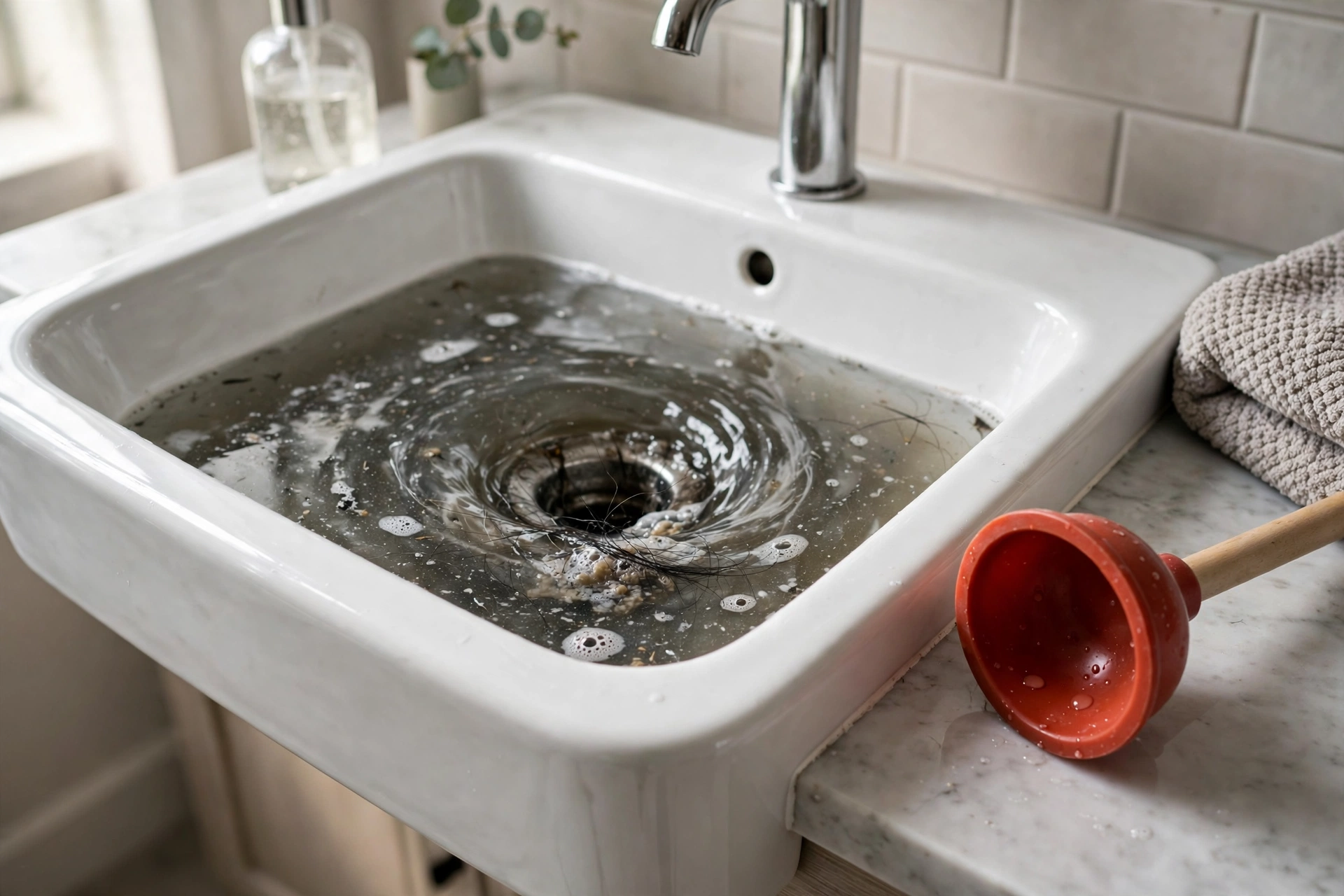
Why Chemical Drain Cleaners Are Risky
This deserves its own section because the bottle is sitting in millions of homes right now, and plumbers are nearly unanimous about it: skip the chemicals.
Chemical drain cleaners work with caustic substances like sodium hydroxide (lye) or sulfuric acid, plus heat-generating reactions that "burn" through clogs (Petersen Products, 2024). The problems:
- They damage pipes. The heat they generate can soften PVC piping and corrode older metal pipes (Petersen Products, 2024). Repeated use etches plastic and accelerates pitting in galvanized and cast iron lines, widening microcracks into pinhole leaks (Rooter Experts, 2026).
- They often do not fully clear the clog. Chemicals typically burn a small channel through the blockage, leaving most of the buildup behind. The drain runs a little better for a while, then clogs again, and the cycle repeats with more chemical damage each time.
- They are dangerous to people. Direct contact causes serious skin and eye burns, and the fumes can injure lungs. They must only be used in ventilated areas with protection (Petersen Products, 2024). Worse, if the chemicals fail and you call a plumber, the standing water in your pipes is now caustic, which is a hazard for whoever works on it next.
- They harm septic systems. Septic systems rely on beneficial bacteria to break down waste, and chemical cleaners kill those bacteria, impairing the whole system (Petersen Products, 2024).
Real talk: If you have already used chemical cleaner and the drain is still clogged, tell the plumber before they start work. Caustic water sitting in a pipe is a safety issue for whoever opens that trap. It takes ten seconds to mention and prevents a chemical burn.
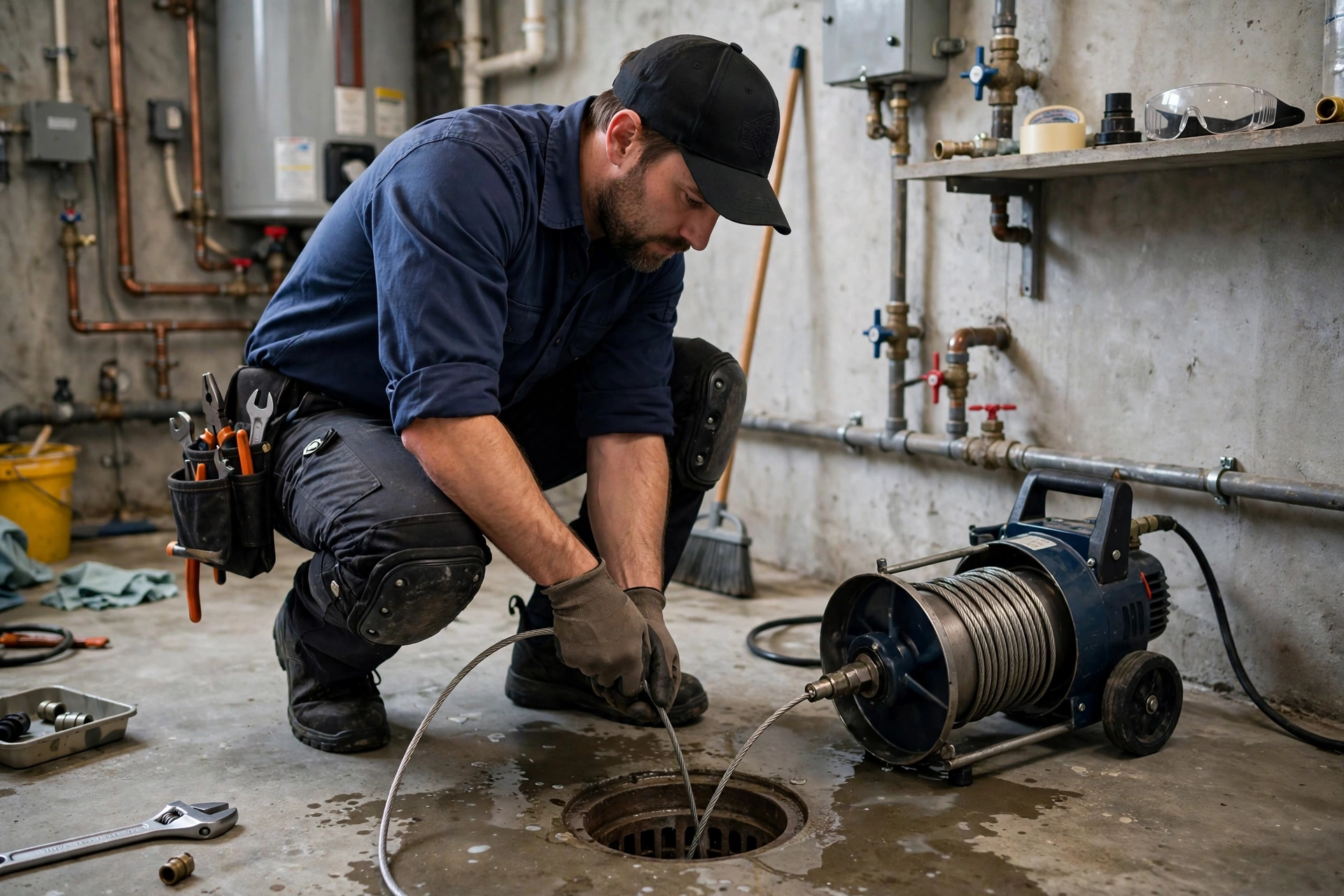
When a Clog Means Something Bigger
Some drain symptoms point past the fixture and into the main line or sewer. Treat these as professional territory:
- Gurgling in multiple drains, especially toilets bubbling when another fixture drains. Air is being forced through traps because the main line is restricted.
- Sewage backing up into tubs, showers, or floor drains. This is a main line blockage, full stop. Minimize water use immediately.
- Recurring clogs in the same drain every few months. The underlying cause (roots, grease buildup, pipe belly, scale) is still there; clearing the symptom does not fix it.
- Clogs plus soggy spots or odors in the yard. A damaged sewer lateral can leak underground. Our sewer line repair page covers what happens next.
A professional has two tools you do not: a camera and a jetter. A sewer camera inspection (nationally $100 to $300) shows exactly what and where the problem is, which turns guessing into knowing (Royal Class Service, 2026). Hydro jetting (nationally $300 to $800+, averaging around $475) scours the inside of the pipe with high-pressure water, clearing grease, roots, and scale far more thoroughly than any snake (Angi, 2026). For a main line, the camera-plus-jetting combination is the gold standard, and it is dramatically cheaper than excavating a line that only needed cleaning. See our drain cleaning page for the methods we use.
Low Water Pressure: Diagnose in This Order
Low water pressure has a completely different set of causes from drain problems, but the diagnostic approach is the same: start with the simplest, most local explanation and work outward.
Step 1: Is it one fixture or the whole house?
One weak faucet is a fixture problem. The whole house losing pressure is a system problem. This single question eliminates half the possibilities instantly.
Step 2: For a single fixture, check the aerator
Unscrew the aerator (the small screen at the faucet tip), rinse out the sediment and mineral deposits, and screw it back on. For showerheads, unscrew the head and check its inlet screen, or soak it in vinegar to dissolve mineral buildup. This fixes a large share of single-fixture pressure complaints for free. If you need a fixture serviced or replaced, see our faucet repair page.
Step 3: Check the shutoff valves
Under-sink and behind-toilet shutoff valves sometimes get left partially closed after past work. Make sure they are fully open. Also check your main shutoff valve where water enters the house; a partially closed main valve throttles the whole system.
Step 4: Test your pressure and check the PRV
Screw a $10 pressure gauge onto an outdoor hose bib. Normal residential pressure is roughly 40 to 80 psi. If the whole house reads low, look at the pressure reducing valve (PRV), usually a bell-shaped device near the main shutoff. PRVs wear out over 10 to 15 years and can stick in a low-pressure position. A failing PRV is a common, fixable cause of house-wide pressure loss.
Step 5: Look for hidden leaks
A leak in a supply line bleeds off pressure before water reaches your fixtures. Warning signs: an unexplained jump in the water bill, damp spots, musty odors, the sound of running water when nothing is on, or a water meter that moves when all fixtures are off. Hidden leaks only get worse, so this one is worth professional leak detection sooner rather than later.
Step 6: Consider the pipes themselves
In older homes with galvanized steel supply lines, mineral deposits and corrosion narrow the pipe interior over decades, strangling flow. This shows up as pressure that has declined gradually over years, often worse on hot water lines. No cleaning fixes it; the long-term answer is replacing those sections, which our repiping page covers. A water softener will not fix already-narrowed pipes, but it slows future mineral buildup significantly.
Step 7: It might be the municipal supply
Sometimes the problem is not in your house at all. Ask neighbors whether their pressure dropped too, or check with your water utility about main work, hydrant flushing, or supply issues in your area. If the whole street is affected, no plumber can fix it, and you will save a service call by checking first.
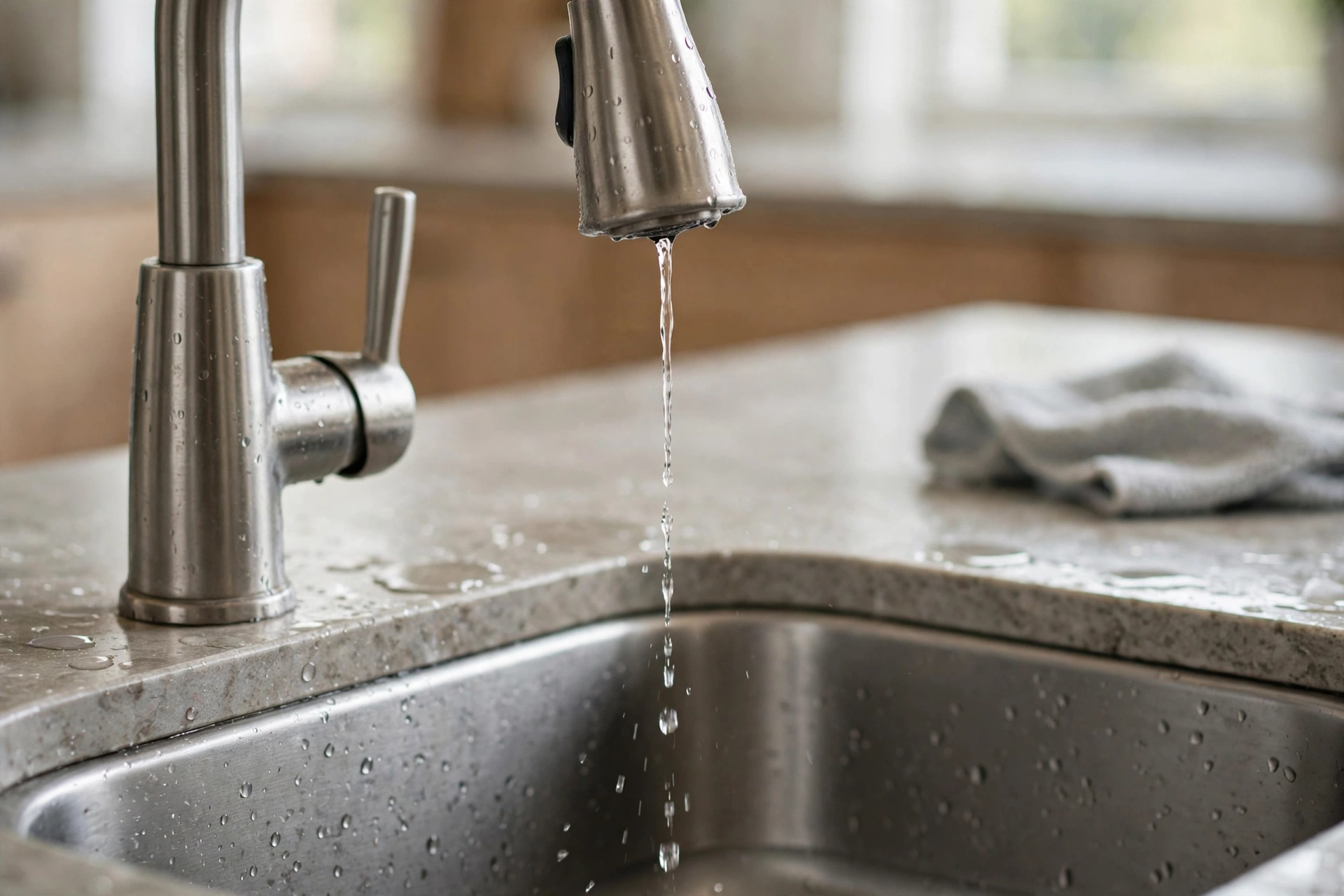
Real talk: Gradual pressure loss over years in an older home is almost never "just how it is." It is usually mineral buildup or corrosion narrowing the pipes, and it will keep getting worse. Catching it early means replacing sections; ignoring it means emergency repiping later at the worst possible time.
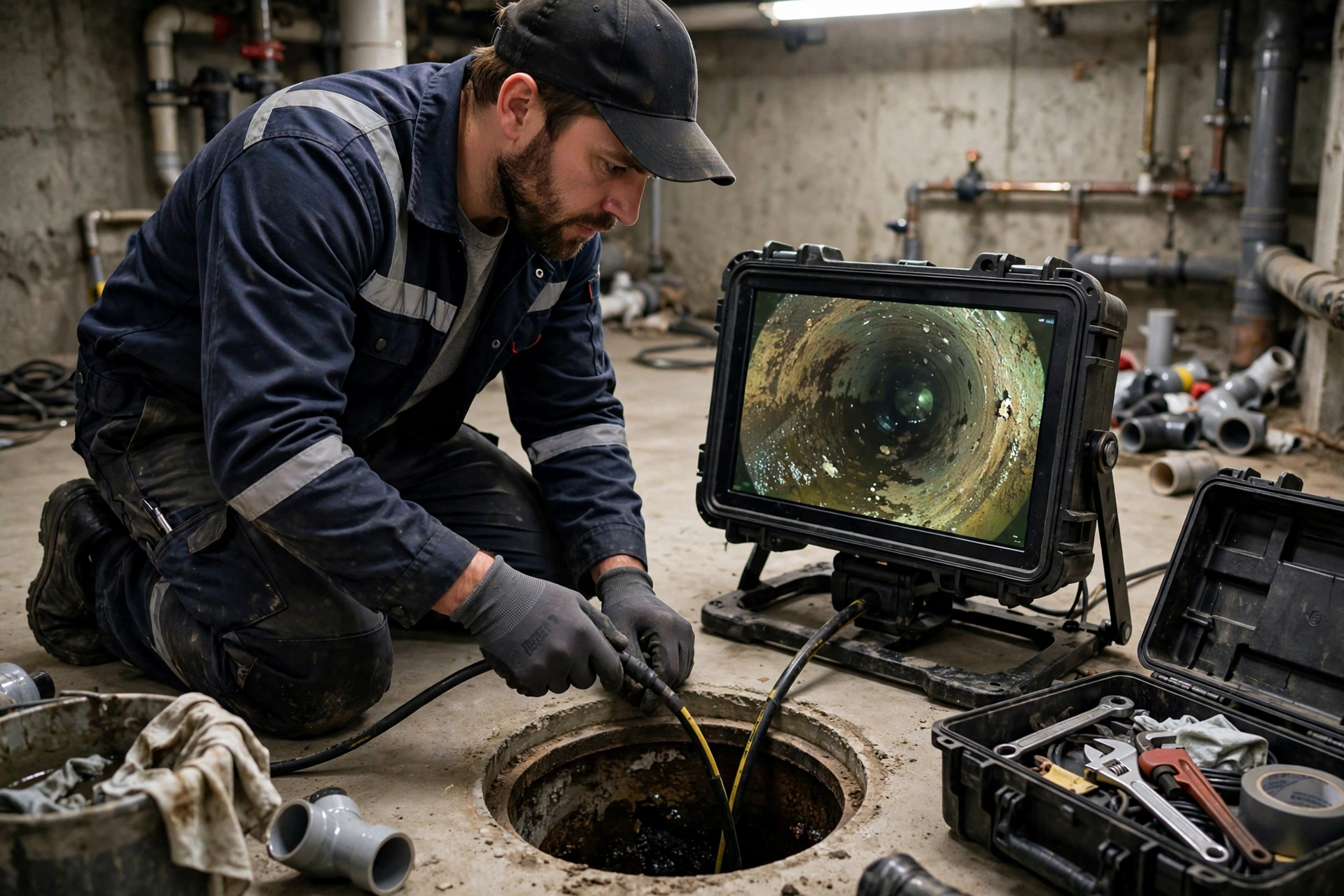
Preventing Clogs: Habits That Actually Work
Clearing a clog is satisfying; never getting one is better. Most drain problems are caused by a short list of habits, and changing them costs nothing.
- Grease goes in the trash, never the drain. Pour cooking grease into a can, let it solidify, and throw it out. Even small amounts, rinsed with hot water "to keep it moving," cool and harden further down the line where you cannot reach them. This single habit prevents more kitchen clogs than everything else combined.
- Use drain strainers everywhere. A $3 mesh strainer in every tub, shower, and sink catches the hair and food particles that become clogs. Empty them weekly. It is the highest return-on-effort plumbing habit there is.
- Run hot water after kitchen use. After doing dishes, run hot water for 30 seconds to move residual grease and soap further down the line before it cools. It is not a substitute for keeping grease out, but it helps with the traces.
- Flush only the three Ps. Pee, poop, and toilet paper. Wipes (even "flushable" ones), cotton products, dental floss, and paper towels do not break down and are among the most common things plumbers pull from clogged lines.
- Know where your cleanouts are. A sewer cleanout is a capped pipe, usually outside near the foundation or in the basement, that gives direct access to the main line. Knowing its location before you have a problem saves the plumber time (and you money) when a main-line issue strikes.
- Be careful what goes in the garbage disposal. Disposals handle soft food scraps, not fibrous vegetables (celery, artichokes), starchy pastes (potato peels, rice), coffee grounds in volume, or grease. When in doubt, the trash can is the safer destination. See our garbage disposal repair page for common issues.
For homes with recurring grease or soap buildup, a monthly enzyme treatment keeps organic deposits from accumulating. Think of it as brushing your teeth for your drains: it does not fix cavities, but it prevents most of them.
Winter Watch: Pressure Drops and Frozen Pipes
In Illinois winters, a sudden pressure loss or a complete stop at one fixture can mean a frozen supply line rather than a clog or valve issue. Pipes in exterior walls, crawl spaces, garages, and unheated basements are the usual victims. If you suspect freezing, open the affected faucet slightly (this relieves pressure as ice thaws), warm the area gently, and never use an open flame on a pipe. If a frozen pipe has already burst, shut off the main valve immediately and call for frozen pipe repair. Prevention is simple: insulate exposed pipes, seal drafts near plumbing, let vulnerable faucets drip during extreme cold snaps, and keep the thermostat steady even when you are away. A burst pipe from freezing is one of the most expensive and most preventable plumbing emergencies there is.
What NOT to Do
- Do not pour chemical drain cleaner into a fully blocked drain. It will sit on top of the clog, generating heat against one spot in the pipe, achieving nothing except pipe damage and a caustic mess.
- Do not mix drain cleaners. Mixing different chemical products can create toxic fumes or violent reactions.
- Do not snake a drain after using chemicals without full protective gear and flushing first. The cable comes back coated in caustic residue.
- Do not ignore a main-line backup. Continued water use during a sewer backup pushes sewage further into the home. Stop, then call.
- Do not crank the PRV adjustment yourself without a gauge and knowledge of your system's limits. Over-pressurizing stresses supply lines, water heater relief valves, and appliance hoses. High pressure causes its own damage, including burst lines.
- Do not flush "flushable" wipes. They do not break down like toilet paper and are one of the most common causes of clogs plumbers pull out of lines.
- Do not pour grease down the kitchen drain. It solidifies in the pipes, and it is the number one ingredient in kitchen clogs. Wipe pans with a paper towel and toss it.
When to Call a Professional
Call when: multiple fixtures are affected; sewage is backing up anywhere; the same drain clogs repeatedly; you suspect a hidden leak (rising bill, damp spots, meter movement); pressure dropped suddenly across the whole house; your DIY attempts have not worked; or the job involves the main line, gas-adjacent work, or anything behind walls. A professional diagnosis with a camera costs far less than the damage from guessing wrong. You can reach us at (618) 573-0073 or through our contact page, and our about page explains how we work.
Frequently Asked Questions
What is the best way to clear a slow bathroom drain?
Start by removing and cleaning the stopper (hair is the usual culprit), then plunge with the overflow sealed, then clean the P-trap, then use a hand auger. Most single-fixture clogs clear at one of these steps. Skip chemical cleaners, which damage pipes and often leave the clog partially intact.
Are chemical drain cleaners bad for pipes?
Yes. Caustic and acid-based cleaners generate heat that can soften PVC and corrode metal pipes, and repeated use accelerates pitting and leaks, especially in older plumbing (Petersen Products, 2024; Rooter Experts, 2026). They also kill the beneficial bacteria in septic systems.
Why do all my drains gurgle and back up at once?
That pattern points to a blockage in the main sewer line, not individual fixtures. Tree roots, grease buildup, or a damaged pipe section are common causes. Minimize water use and call a plumber; a camera inspection will locate the problem precisely.
How much does professional drain cleaning cost?
Nationally, basic snaking runs $100 to $275, hydro jetting $300 to $800+ (averaging around $475), and camera inspections $100 to $300 (Royal Class Service, 2026; Angi, 2026). Main sewer line work can run higher depending on severity and access.
Why is my water pressure suddenly low throughout the house?
Check whether neighbors are affected first (municipal issue), then verify the main shutoff is fully open and test pressure with a gauge. Common in-home causes include a failing pressure reducing valve, a hidden leak, or narrowed older pipes. A sudden drop can also signal a significant leak, so do not ignore it.
Can low water pressure mean I have a leak?
It can. A hidden supply-line leak bleeds pressure before water reaches fixtures. Other warning signs include a rising water bill, damp spots, musty smells, or a water meter that moves with everything off. Professional leak detection can pinpoint it without tearing open walls blindly.
Related Guides
References
- Royal Class Service. (2026). How much does drain cleaning cost in 2026? Professional & DIY prices. https://www.royalclassservice.com/blog/how-much-does-drain-cleaning-cost
- Angi. (2026). How much does hydro jetting cost? (2026). https://www.angi.com/articles/hydro-jetting-cost.htm
- Petersen Products. (2024). Avoid harmful chemical drain cleaners and clear your drain. https://www.petersenproducts.com/articles/avoid-harmful-chemical-drain-cleaners-and-clear-your-drain.html
- Rooter Experts. (2026). Is drain cleaner bad for pipes? NJ plumber's honest guide in 2026. https://rooterexpertsdraincleaning.com/is-drain-cleaner-bad-for-pipes/
- WP Plumbing. (n.d.). Hidden dangers damaging your pipes & costing you money. https://wpplumbing.com.au/plumber/information/common-causes-of-pipe-damage
Plumbing problem that won't wait?
Belleville IL Plumbers is available 24/7 across Belleville and St. Clair County. Call (618) 573-0073 for upfront written pricing before any work begins.